Quick Answer: What Adhesive Is Best for Flexible Stone?
For many flexible stone and MCM wall-cladding applications, polymer-modified cementitious adhesives are an important adhesive category to consider. These adhesives are classified under EN 12004, which distinguishes cementitious, dispersion and reaction resin adhesives and defines additional performance designations such as C2, T, E and S1/S2.
However, a C2TE S1 classification does not automatically mean that an adhesive is suitable for every flexible stone product. Adhesive selection should also consider the panel construction, substrate, installation environment, movement requirements, and the adhesive manufacturer’s approved applications.
The final selection should consider:
- Flexible stone panel composition and backing
- Panel size, weight, and thickness
- Substrate type and condition
- Interior or exterior application
- Moisture exposure
- Temperature variation and movement
- Adhesive coverage and installation method
- The adhesive manufacturer’s approved applications
- Compatibility testing where required
For specialized substrates or conditions, dispersion, reaction resin, polyurethane, hybrid polymer, or other bonding systems may also be considered.
Understanding Flexible Stone: Why Standard Glue Fails
Before diving into adhesive types, it’s essential to understand the material’s physical nature. Flexible stone veneer is thin, lightweight, and—as the name suggests—flexible.
Unlike rigid granite or thick ceramic tiles, flexible stone reacts to seasonal temperature shifts and structural micro-movements.
Traditional rigid cement mortar cannot absorb these shifts, leading to cracking or failure.
Therefore, the adhesive must act as a “flexible bridge”, offering high bond strength while accommodating movement.
What Type of Adhesive Is Used for Flexible Stone?
Flexible stone adhesive is not a single standardized adhesive category. There is no standalone international adhesive standard specifically developed for flexible stone.
Instead, flexible stone may be installed using different adhesive systems depending on the panel, backing, substrate, and installation conditions.
For adhesive classification, EN 12004 provides a useful framework for identifying three main adhesive families according to their basic composition: C (cementitious), D (dispersion), and R (reaction resin).
| Classification | Adhesive Family | Typical Form | Common Products / Classifications |
|---|---|---|---|
| C | Cementitious adhesive | Powder mixed with water or a specified liquid | Cementitious tile adhesive Polymer-modified cementitious adhesive EN 12004 classifications: C2, C2TE, C2TE S1/S2 |
| D | Dispersion adhesive | Ready-mixed paste | Ready-mixed dispersion adhesive EN 12004 classifications: D1 / D2 |
| R | Reaction resin adhesive | Reactive resin system, often supplied as two components | Epoxy resin adhesive Two-component epoxy adhesive EN 12004 classifications: R1 / R2 |
| — | Specialized polymer / sealant bonding systems | Ready-to-use or multi-component, depending on product | Polyurethane adhesive Hybrid polymer adhesive Structural silicone adhesive |
C, D, and R describe the basic adhesive family. They should not be confused with performance classifications.
For example, cementitious tile adhesive is a product category within the C family. A cementitious adhesive may be polymer-modified, and its performance can then be classified under EN 12004, such as C2, C2TE, or C2TE S1.
D refers to dispersion adhesives, typically ready-mixed adhesive systems, classified as D1 or D2 under EN 12004. R refers to reaction resin adhesives, such as epoxy-based systems, classified as R1 or R2.
These terms describe different aspects of the product rather than separate adhesive types. C2TE S1, for example, identifies a cementitious adhesive with improved adhesion, reduced slip, extended open time, and S1 deformability.
When choosing a cementitious tile adhesive for flexible stone, start with the product category, then check its formulation and performance classification:
Cementitious tile adhesive → Check whether it is polymer-modified → Check the EN 12004 classification → C2 / C2TE / C2TE S1 → Confirm compatibility with the flexible stone, substrate, and installation conditions.
Which Adhesive Should You Choose?
The substrate is an important starting point, but it should not be considered in isolation. The same flexible stone panel may require a different adhesive system depending on whether it is installed on concrete, plasterboard, existing tile, metal, or another substrate.
| Substrate / Condition | Preparation | Primer / Interface Treatment | Adhesive to Consider | What to Check |
|---|---|---|---|---|
| Concrete / Cement Render | Clean dust, loose material, grease, and other contaminants. Repair damaged or uneven areas. | Usually not required. | Polymer-modified cementitious tile adhesive EN 12004: C2 / C2TE / C2TE S1 or S2, where appropriate | Check substrate strength, flatness, moisture, required deformability, and panel backing. |
| Cement Board / Fiber-Cement Board | Ensure the board is firmly fixed, clean, dry, and free from contaminants. | As required by board surface and absorption. | Polymer-modified cementitious tile adhesive EN 12004: C2 / C2TE / C2TE S1 or S2, where appropriate | Check board stability, joints, surface condition, and panel backing. |
| Existing Ceramic Tile | Confirm the existing tiles are firmly bonded. Remove grease and contaminants from the surface. | Glazed, dense, or low-absorption surfaces: bonding primer required. | Polymer-modified cementitious tile adhesive or epoxy resin adhesive for low-absorption surfaces | Check tile adhesion, surface absorption, glazing, and primer requirements. |
| Plasterboard / Gypsum Board | Ensure the board is sound, securely fixed, clean, and suitable for the intended application. | Highly absorbent surfaces: primer required. | Polymer-modified cementitious tile adhesive or selected ready-mixed dispersion adhesive for suitable interior applications | Check board strength, absorption, moisture exposure, and panel weight. |
| Plywood / Wood-Based Board | Ensure the substrate is sound, securely fixed, clean, and free from contaminants. | Compatible primer: only where required. | Polymer-modified cementitious tile adhesive (e.g. C2 or C2TE S1), where approved, or a suitable specialized polymer bonding system | Check substrate movement, moisture, dimensional stability, and surface condition. |
| Metal / Low-Absorption Substrate | Degrease and thoroughly clean the surface. Remove rust, loose coatings, dust, and other contaminants. | Metal or low-absorption surfaces: bonding primer required. | Reaction resin adhesive, such as a two-component epoxy adhesive, or a suitable specialized polymer bonding system | Check adhesion to the metal or coating, thermal movement, and substrate movement. |
| Wet / High-Moisture Areas | Ensure the substrate is sound, properly prepared, and suitable for the intended moisture exposure. | As required by the waterproofing system. | Water-resistant polymer-modified cementitious tile adhesive, such as an appropriate C2-class adhesive, or a manufacturer-approved reaction resin adhesive where required | Check moisture exposure, waterproofing, substrate compatibility, and curing conditions. |
| Exterior Application | Ensure the substrate is sound, clean, stable, and suitable for exterior installation. | As required by the exterior adhesive system. | Suitable polymer-modified cementitious tile adhesive or another manufacturer-approved bonding system | Check outdoor exposure, temperature variation, moisture, substrate movement, and deformability. |
For exterior applications, the adhesive cannot be evaluated separately from the complete wall assembly. The panel, adhesive, substrate, insulation or render system, joints, and installation method all contribute to long-term performance. For more detail, see our guide to [why flexible stone can be used outdoors].
4. Look Beyond “C2”
One of the most common misunderstandings is that C2 automatically means flexible.
It does not.
Under EN 12004, C indicates a cementitious adhesive, while the number indicates the adhesion class. Other letters and designations provide additional performance information. For cementitious adhesives, S1 indicates deformability and S2 indicates high deformability.
Therefore:
C2 ≠ automatically flexible
And:
C2TE S1 ≠ automatically compatible with every flexible stone panel
If a deformable cementitious adhesive is being considered, reviewing the complete classification provides more useful information than looking only at “C2.”
5. Check the Manufacturer’s Approved Applications
This is one of the most important steps.
Before purchasing an adhesive, check its technical data sheet for:
- Approved substrates
- Approved covering materials
- Interior / exterior suitability
- Maximum panel or tile size
- Recommended adhesive bed thickness
- Open time
- Curing conditions
- Moisture limitations
- Application method
- Required primers or surface preparation
At the same time, check the flexible stone manufacturer’s installation instructions.
If the panel manufacturer specifies an approved adhesive system, that recommendation should take priority over assumptions based only on the adhesive classification.
6. Temperature Resistance
Temperature should be evaluated in two stages: application temperature and service temperature.
During installation, check the adhesive manufacturer’s specified temperature range for the air and substrate. Temperature can affect mixing, open time, working time, curing and final bond development. For example, some C2TE S1 cementitious adhesives specify application temperatures around +5°C to +30°C or +40°C. Product Technical Data Sheet
For exterior applications, also check the adhesive’s service temperature range after curing. Some products are designed to withstand substantial temperature variation, with published service ranges such as -30°C to +90°C. However, this is product-specific and should not be assumed from the C2TE S1 classification alone.
For flexible stone installations, pay particular attention to projects exposed to direct sunlight, large daily or seasonal temperature changes, freeze-thaw conditions, or substrates with significant thermal movement.
What to check in the TDS:
- Application temperature range
- Substrate temperature requirements
- Service temperature range
- Suitability for exterior or freeze-thaw exposure
- Any temperature-related limitations during curing
7. Application Compatibility
The adhesive must be compatible not only with the panel and substrate, but also with the installation method and working conditions.
Before installation, review the adhesive manufacturer’s technical data for the recommended mixing ratio, pot life, open time, adjustment time, adhesive bed thickness, application method, coverage and curing or waiting time.
These parameters can vary significantly between products. For example, published C2TE S1 products may specify different open times, bed thicknesses, adjustment times and coverage rates depending on their formulation and intended application.
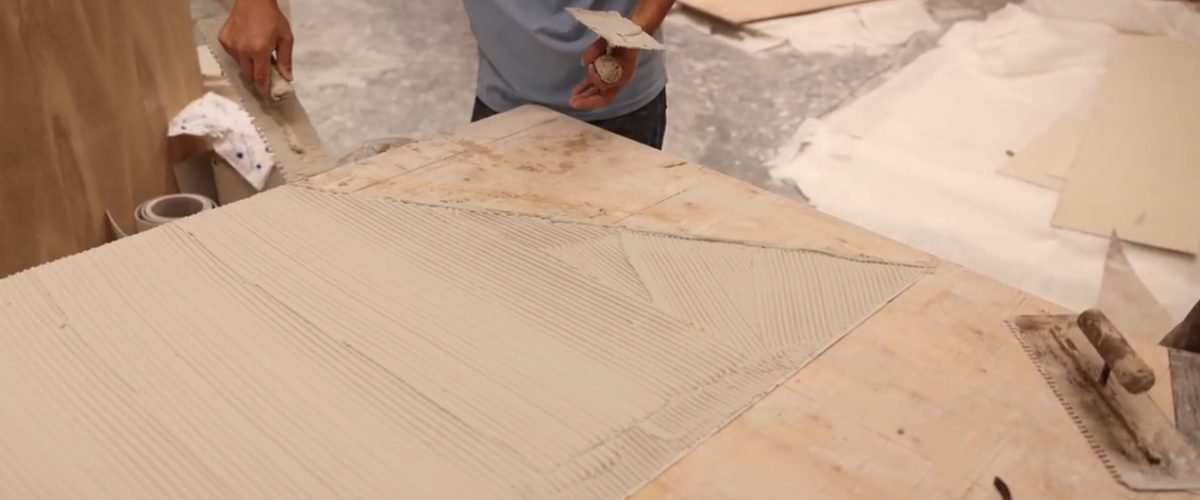
For flexible stone, also confirm that the recommended application method provides sufficient adhesive contact with the panel. Coverage requirements may depend on the panel size, substrate flatness, surface profile and whether the adhesive is applied to the substrate only or combined with back-buttering.
What to check in the TDS:
- Mixing ratio and mixing procedure
- Pot life
- Open time
- Adjustment time
- Recommended adhesive bed thickness
- Trowel or application method
- Required adhesive coverage
- Initial curing or waiting time
- Time before grouting, loading or opening the area to use
- Any limitations related to substrate, panel size or installation conditions
Do not select an adhesive based only on its EN 12004 classification. The product’s application parameters must also be suitable for the actual flexible stone panel, substrate and installation method.
For project-specific guidance, explore Romantic Stone’s MCM flexible stone panels to review available products and finishes. Understanding the panel specifications and intended application is an important step in assessing adhesive compatibility. If you need further information about our manufacturing capabilities and technical approach, visit our About Us page or contact our team to discuss your project requirements.
What About Other Adhesive Types?
Cementitious adhesives are not the only possible solution.
Dispersion adhesives (D) are ready-mixed systems that can be convenient for selected interior applications. However, their suitability depends on the specific product, substrate, covering, and environmental conditions. Some products are intended only for internal applications or require an absorbent substrate.
Reaction resin adhesives (R) use reactive synthetic resins that cure through a chemical reaction. Depending on the formulation, they may offer high water resistance, chemical resistance, or strong adhesion to selected low-absorption substrates.
Polyurethane and hybrid polymer adhesives can also be used in certain applications. However, PU, MS polymer, or hybrid should not simply be treated as additional EN 12004 categories alongside C, D, and R. They are specific chemical or product technologies, and their suitability must be confirmed from the manufacturer’s technical documentation.
The same principle applies to epoxy or other specialized bonding systems:
A specialized adhesive is not automatically a better adhesive.
The chemistry must match the panel, substrate, environment, and installation method.
Does Flexible Stone Always Need C2TE S1?
No.
C2TE S1 is a specific cementitious adhesive classification, not a universal specification for flexible stone.
For a compatible mineral substrate and flexible panel, a suitable polymer-modified cementitious adhesive with appropriate deformability may be an effective solution.
For a selected interior application, a ready-mixed dispersion adhesive may also be appropriate if the product manufacturer approves the panel and substrate.
For a difficult or low-absorption substrate, a reaction resin or specialized polymer adhesive may be more appropriate.
The correct question is therefore not:
“Which adhesive is the strongest?”
It is:
“Which adhesive system is compatible with this flexible stone panel, substrate, environment, and expected movement?”
FAQ
Is C2 adhesive suitable for flexible stone?
Not necessarily. C2 indicates improved adhesion performance, but it does not by itself indicate deformability or compatibility with a particular flexible stone panel. If movement accommodation is important, the complete classification and the manufacturer’s application requirements should be considered.
Is C2TE S1 a flexible adhesive?
C2TE S1 is a cementitious adhesive classification that includes S1 deformability. S1 indicates that the adhesive meets the relevant deformability requirements. However, the classification alone does not prove compatibility with every flexible stone product.
Can I use ordinary tile adhesive for flexible stone?
It depends on the product. Do not select an adhesive simply because it is marketed as a tile adhesive. Check whether the specific cementitious adhesive is approved for the flexible stone panel, substrate, and installation conditions, and review its EN 12004 classification and deformability where relevant.
Can ready-mixed adhesive be used for flexible stone?
Yes, for small interior applications such as TV feature walls and other dry, stable surfaces. For exterior, wet, or high-movement applications, a suitable cementitious or reaction resin adhesive is generally preferred.
What is the best adhesive for exterior flexible stone?
For most compatible mineral substrates, a polymer-modified cementitious adhesive rated C2 S1 or S2 is suitable for exterior flexible stone. It should provide adequate deformability and resistance to moisture, temperature changes, and freeze-thaw exposure.
Final selection should consider the substrate, flexible stone backing, panel size, and complete installation system.
When do I need a bonding primer for flexible stone?
A bonding primer is typically needed on glazed, dense, or low-absorption surfaces, such as existing ceramic tiles or metal. Highly absorbent substrates may also require a suitable primer. On clean, sound, and suitably absorbent mineral substrates, primer is generally not required.
Can flexible stone be installed over existing tiles?
It can be possible when the existing tiles are firmly bonded, the surface is properly prepared, and the selected adhesive is approved for both the existing substrate and flexible stone panel. A compatibility or adhesion test may be appropriate before full-scale installation.
Does the adhesive affect the fire rating of flexible stone?
Yes. Fire performance should be evaluated for the tested product or assembly rather than assumed from the panel material alone. If a project requires a specific fire classification, confirm that the tested configuration, including the adhesive and installation method where applicable, matches the proposed application and supporting documentation.
Is epoxy adhesive suitable for flexible stone?
It can be appropriate for selected applications, particularly where a low-absorption substrate or specific environmental resistance requires a reaction resin system. However, epoxy is not automatically a better choice than a cementitious or polymer adhesive. Check compatibility with the flexible stone backing, substrate movement, working conditions, curing requirements, and the manufacturer’s approved application.
Final Takeaway
There is no single “best adhesive” for every flexible stone application.
Cementitious, dispersion, and reaction resin systems provide a useful starting framework, but the adhesive should ultimately be selected as part of a complete bonding system:
Flexible Stone Panel + Adhesive + Substrate + Environment + Installation Method
Before installation, review the technical data sheets of both the flexible stone panel and the adhesive. For unfamiliar substrates, unusual applications, or demanding environments, conduct a small-scale compatibility or adhesion test before full installation.
Looking for the right flexible stone solution for your project? Explore our MCM Flexible Stone Panels to review available textures, finishes, and product options. Refer to the relevant product specifications and consult our team to help assess suitability for your substrate and installation conditions.